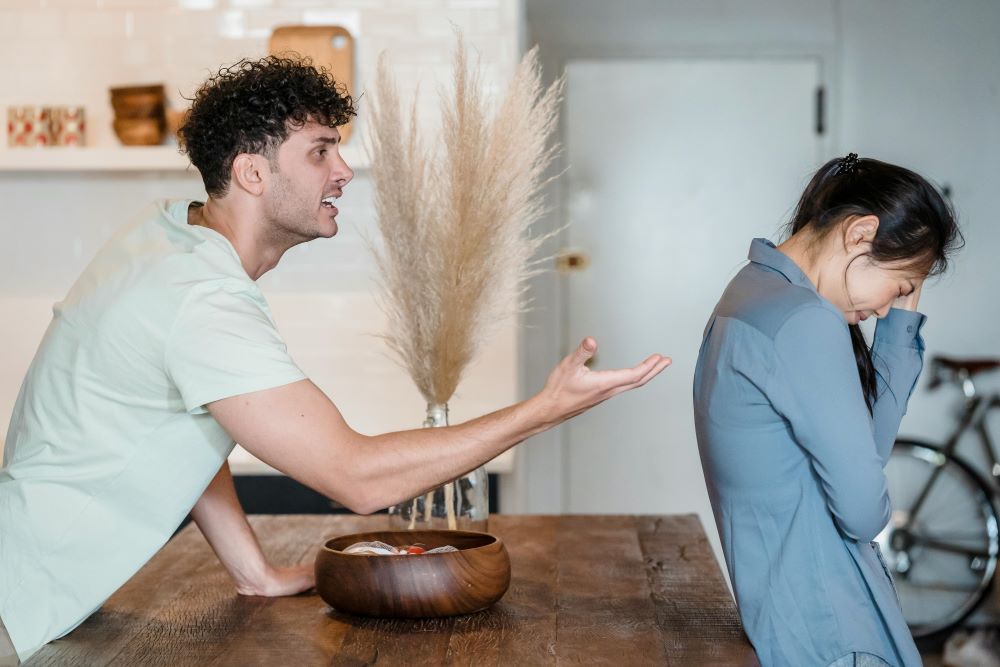






We’re not just learning about parenthood through family or community anymore. We’re learning it through screens, fragments, and curated snapshots of other people’s lives, and slowly that changes how it feels before it even begins.
What we see is often a highly refined version of family life: calm homes, aesthetically organized spaces, children who seem endlessly well-behaved, and parents who appear emotionally composed even in moments that are supposed to be chaotic. Even when reality exists underneath, it is rarely what is shown.
Perfect illusion
Without noticing it, parenting starts to look less like something you grow into, and more like something you’re supposed to already be good at.
For a generation already shaped by comparison culture, this becomes a quiet but constant reference point. Instead of inspiration, it often turns into hesitation, a subtle feeling of I’m not sure I could do that well enough.
Comparison as internal judgment.
This doesn’t stay external. It becomes internal judgment. Other people’s curated lives turn into personal standards.
Many young adults today don’t simply ask whether they want children. The question becomes whether they are emotionally developed enough, stable enough, self-aware enough, and mentally prepared enough to raise one “correctly.” This reflects something broader about our time: psychological awareness has increased significantly, with more language around trauma, attachment, and emotional development than previous generations had at this stage of life. While that awareness is valuable, it also raises the threshold for what people believe they must already be before they begin.
In other words, parenting is no longer seen only as something you do. It is seen as something you must already be fully ready for.
Readiness pressure
And that is where the idea of readiness starts to shift into something heavier than it was meant to be.
Because what makes this generation’s hesitation distinct is not just external conditions, but internal standards. It is no longer enough to want children or imagine family life in the future. There is a growing expectation that you should already feel emotionally equipped to handle every possible outcome before anything has even started.
But most research on confidence in complex life roles points in the opposite direction. Confidence is rarely a prerequisite for action, it is something that forms through experience, repetition, and gradual adaptation over time.
The myth of being ready first.
Parenting has always followed that pattern. Historically, it was not learned in isolation or through preparation alone, but through proximity, extended families, communities, and intergenerational households where learning happened by being around it, not by anticipating it from a distance.
As those structures have weakened, parenting has become more individual, more internal, and more self-evaluated. And in that shift, the process itself has become harder to see. Instead of learning through exposure, people are left imagining it in theory, and theory almost always feels more absolute than reality.
This creates something more subtle than simple hesitation. It is not just fear of parenting itself, but fear of identity change, the sense that you would need to become a fully different version of yourself before you could even begin, and uncertainty about whether that version already exists within you.
The fear isn’t parenting, it’s identity
But confidence was never meant to exist at the starting point. It was always something that forms after entry, not before it. In practice, it grows through repetition, adjustment, and the slow accumulation of experience rather than a moment of internal certainty.
Still, it would be too simple to say this generation is rejecting parenthood. In reality, most people still want connection, partnership, and family. What has changed is not desire, but self-scrutiny. And that creates a paradox: the more seriously people take parenting, the harder it becomes to feel ready for it.
We confuse readiness with permission.
We tend to confuse readiness with permission, as if there were a correct internal state we are supposed to reach before we are allowed to begin something as complex as raising a child. But readiness was never something that existed in advance. It was always something that formed through experience, adjustment, and time.
And maybe what we are witnessing is not a loss of confidence in parenthood, but a change in how we think confidence is supposed to appear.
Because in practice, not in theory
Confidence doesn’t come from having everything figured out beforehand. Our generation still wants what so many of us quietly yearn for: partnership, stability, and a real sense of legacy. If we can move past perfection and performance and instead move toward practice, not in theory, then perhaps today’s hesitation can become something more grounded and real. Not because fear disappears, but because it stops being the thing that decides for us. In the end, confidence is built by stepping forward anyway, and learning as we go.
Isabel Carmo | Contributing Writer